Revenue Stages vs Product Stages: A Two-Dimensional View of Account Health
Most SaaS teams track customer health with a single number. A composite score, usually ranging from 0 to 100, that blends usage data, support tickets, NPS responses, and billing status into one tidy metric. It feels scientific. It looks good on a dashboard. And it regularly fails to tell you what is actually happening inside an account.
The problem is not the data going into the score. The problem is the compression. When you flatten multiple dimensions of customer behavior into a single axis, you lose the very distinctions that should drive your next action. A paying customer who has stopped logging in looks identical to a trial user who is deeply engaged — if both happen to land on the same score. But the playbook for each could not be more different.
There is a better way to think about account health, and it starts with separating two questions that are often conflated:
- where does this account stand financially?
- where does it stand behaviourally?
Why One Dimension Is Not Enough
Traditional health scores attempt to answer a compound question: "How healthy is this account?" But health means different things depending on what you are trying to protect or grow.
A customer on an annual contract with three months remaining and zero logins in the past 30 days is financially healthy today. They are paying. They are not at risk of immediate revenue loss. But behaviorally, they are dormant — and when renewal time comes, you will be having a very different conversation than you expected.
Conversely, a trial user who has integrated your API, invited two teammates, and logged in every day this week is behaviorally healthy. They are activated and engaged. But they have not converted yet, and if no one reaches out at the right moment, that engagement may peak and fade before it translates to revenue.
Single-dimension scoring hides these dynamics. What teams need instead is a framework that preserves both signals independently, making it possible to see at a glance which accounts need attention and what kind of attention they need.
Revenue Stages: Where the Account Stands Financially
Revenue stages describe the billing relationship between your company and the account. They are derived from subscription and payment data, and they change based on financial events — a new subscription, a cancellation, a failed payment, an expiration.
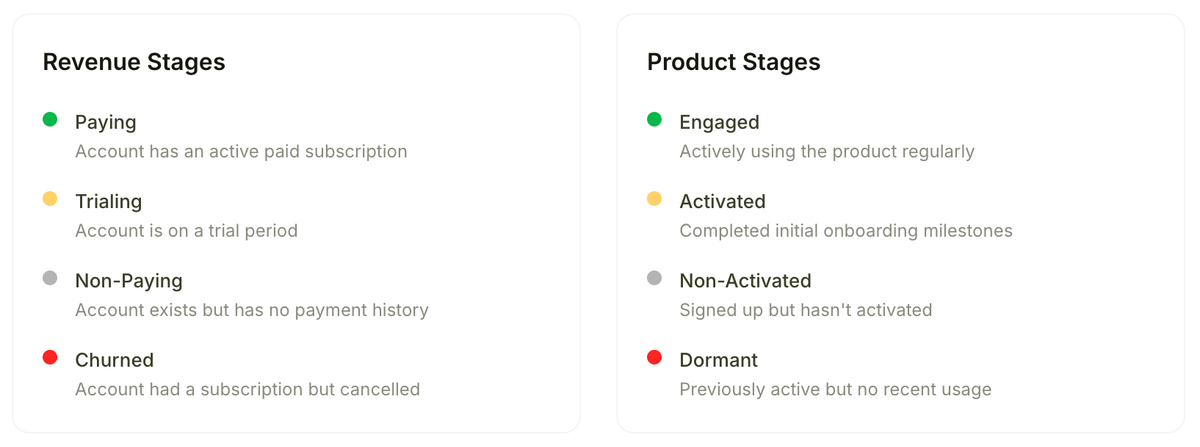
There are four revenue stages:
- Paying — The account has an active, paid subscription. Revenue is flowing.
- Trialing — The account is in an active trial period. No revenue yet, but intent is present.
- Non-Paying — The account exists but has no active subscription or trial. This includes free-tier users and accounts that let a trial expire without converting.
- Churned — The account previously paid but has since canceled or let their subscription lapse.
These stages are objective. They are determined by billing system data, not by judgment calls or threshold tuning. An account is either paying or it is not. It is either in a trial or it is not. This clarity is what makes revenue stages reliable as one axis of your framework.
Product Stages: What the Account Is Actually Doing
Product stages describe the behavioral relationship between the account and your product. They are derived from usage data — event streams, feature adoption, login frequency, and whatever signals matter most for your product's activation and engagement model.
There are four product stages:
- Engaged — The account is actively using the product in a meaningful, sustained way.
- Activated — The account has completed key onboarding milestones but has not yet reached consistent engagement.
- Non-Activated — The account exists but has not completed the actions that indicate they understand or are using the product's core value.
- Dormant — The account was previously active but has gone quiet. Usage has dropped below a meaningful threshold.
Product stages require more configuration than revenue stages because "engaged" means something different for every product. But once defined, they provide a behavioral lens that billing data alone cannot offer.
The Two-Dimensional Matrix
When you combine revenue stages and product stages, you get a matrix that maps every account into a position defined by two independent axes:
| Engaged | Activated | Non-Activated | Dormant | |
|---|---|---|---|---|
| Paying | Expansion Target | Nurture | Onboarding Gap | Churn Risk |
| Trialing | Conversion Candidate | Guide to Value | At-Risk Trial | Likely Lost |
| Non-Paying | Upgrade Opportunity | Free-Tier User | Unactivated Signup | Inactive |
| Churned | Win-Back Opportunity | Re-engage | Lost | Gone |
Every cell in this matrix suggests a different motion. That is the power of two dimensions — you are no longer asking "is this account healthy?" but rather "what does this account need right now?"
Not every cell demands equal attention. Five combinations, in particular, deserve dedicated playbooks.
Five Combinations That Demand Action
1. Paying + Engaged: Expansion Targets

What it means: These accounts are getting real value from your product and paying for it. Usage is strong. The relationship is working.
Why it matters: This is your best segment for revenue growth. Engaged, paying customers are the most receptive to upsell conversations, additional seat purchases, and premium feature adoption. They are also your strongest candidates for referrals, case studies, and reviews.
What to do: Trigger expansion-focused outreach. Surface upgrade paths based on the features they use most. Invite them into beta programs. Ask for referrals. The goal is not to protect this segment — it is to grow it.
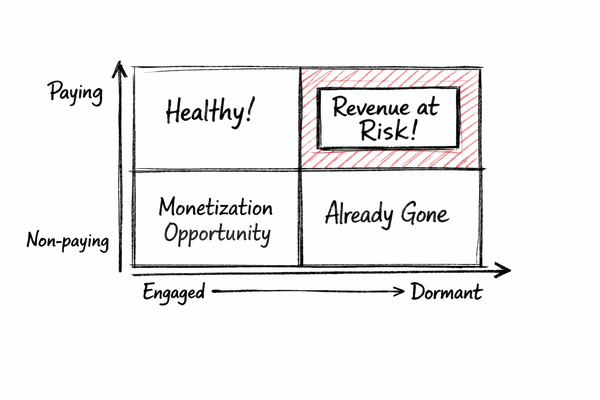
2. Paying + Dormant: Churn Risk

What it means: The account is paying, but no one is using the product. The subscription is active, but the relationship is not.
Why it matters: This is the most dangerous segment in your book of business. These accounts will churn at renewal. The only question is whether you notice in time. Every day of dormancy is a day closer to a cancellation you did not see coming.
What to do: Trigger re-engagement sequences immediately. Assign a CSM to personal outreach. Offer a check-in call, a guided session, or a reset of their onboarding experience. The goal is to re-establish usage before the renewal conversation happens.
3. Trialing + Engaged: Conversion Candidates

What it means: The account is in a trial and is actively using the product. They are seeing value. They are investing time.
Why it matters: Engaged trial users are the highest-probability conversion targets in your pipeline. But engagement alone does not guarantee conversion — pricing confusion, procurement friction, or simple inertia can prevent the deal from closing.
What to do: Make the conversion path frictionless. Send a personalized note acknowledging their usage. Offer to answer questions about pricing or plans. If your trial has a time limit, ensure they know exactly when it ends and what happens next. Remove every obstacle between engagement and payment.
4. Trialing + Non-Activated: At-Risk Trials

What it means: The account signed up for a trial but has not completed the actions that indicate real usage. They might have logged in once, looked around, and left.
Why it matters: Non-activated trials almost never convert. The trial period is burning down, and the account has not experienced the product's core value. Without intervention, this account will expire silently.
What to do: Trigger onboarding support immediately. Send targeted guidance based on what they have not done yet. Offer a live walkthrough or a quickstart call. The goal is not to sell — it is to get them to the moment of value before the trial clock runs out.
5. Churned + Engaged: Win-Back Opportunities

What it means: The account canceled their subscription but has come back and is actively using the product — perhaps on a free tier, or through a residual access window.
Why it matters: This is the most overlooked segment. The account already knows your product. They left for a reason, but their return signals that the reason may no longer apply, or that no alternative worked. Re-engagement after churn is a strong buying signal.
What to do: Reach out personally. Acknowledge they are back. Ask what changed. Offer a return incentive — a discount, an extended trial of a new feature, or simply a conversation about what was missing before. Win-back customers often become more loyal than first-time buyers because the relationship has been tested.
Operationalizing the Framework
A framework only works if it is embedded in your daily operations, not sitting in a strategy deck. Here is how to make two-dimensional account health actionable.
Automate stage assignment. Revenue stages should be derived automatically from your billing system. Product stages should be computed from event data in real time. Manual tagging does not scale and introduces lag that defeats the purpose. In Bigdelta, both stage types are assigned automatically — revenue stages from billing data and product stages from usage events — so every account always has a current, accurate position in the matrix.
Build filtered views for each priority segment. Your CS team should not have to query a database to find paying-but-dormant accounts. They need a saved view they can open every morning. Bigdelta Stages Comparison view lets you filter and sort accounts by any combination of revenue and product stages, then save those views for repeated use.
Attach automated playbooks to stage transitions. The moment an account moves from Engaged to Dormant, or from Trialing to Non-Activated, the right action should trigger without waiting for someone to notice. This is where automation turns a framework into a system. Bigdelta Moments feature lets you define automated playbooks for each segment — so the right outreach, alert, or internal notification fires the instant a stage transition occurs.
Make stages visible everywhere. Both stages should appear in your accounts list, in individual account profiles, and in any reporting your team reviews. If a CSM has to navigate to a separate tool to see an account's product stage, they will stop checking. Visibility drives adoption.
Moving Beyond the Single Score
The appeal of a single health score is simplicity. But simplicity that hides critical distinctions is not a feature — it is a liability. When your team cannot tell the difference between a paying customer who has gone dark and a trial user who is thriving, they cannot act with precision.
Two-dimensional account health gives you that precision. Revenue stages tell you where the money is. Product stages tell you where the engagement is. Together, they tell you what to do next.
If you are ready to move beyond composite scores and start managing accounts based on what is actually happening, Bigdelta gives you the infrastructure to do it — automated stage assignment, filtered views for every segment, and playbooks that trigger the right action at the right time.
You can try Bigdelta free at bigdelta.com.