The 4 Moments That Determine Whether a SaaS Customer Stays or Leaves

You track MRR. You measure churn rate. You measure trial-to-paid conversion.
These are lagging indicators. By the time MRR drops, the customer is already lost. By the time your churn rate spikes, you've lost three accounts you could have saved.
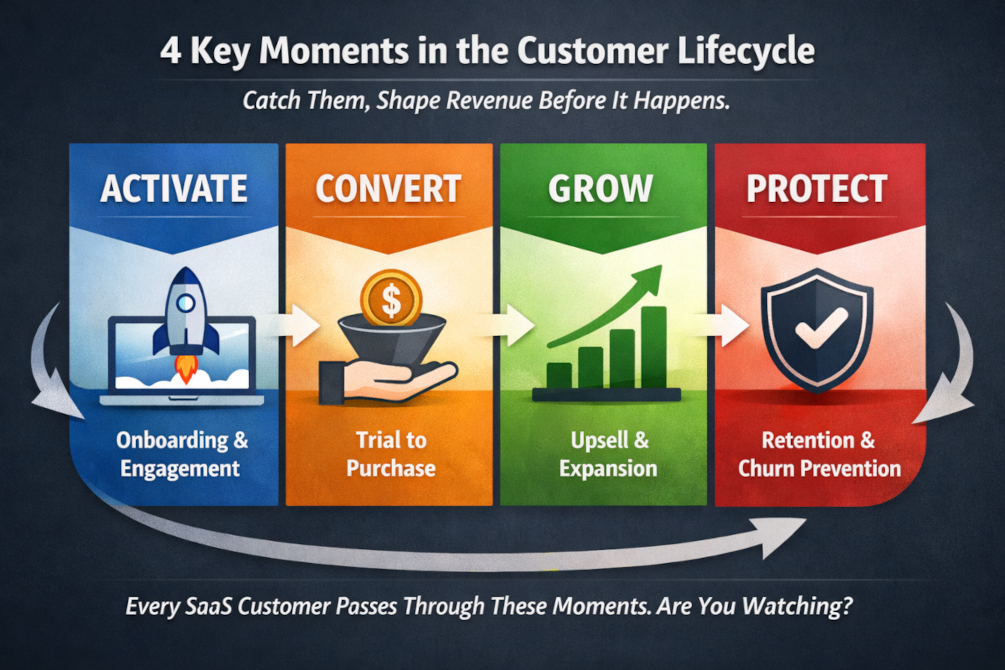
There are exactly 4 moments in a customer's lifecycle where you can change the outcome. Miss them, and you're reacting to damage. Catch them, and you're shaping revenue before it happens.
We call them Moments: Activate, Convert, Grow, and Protect. Every SaaS customer passes through them. Most SaaS companies aren't watching.
Moment 1: Activate
The question: Did this customer experience enough value to care?
A new account signs up. They check your product. Maybe they invite a teammate. Maybe they don't. Three days pass. Then seven. Then they're gone.
This is the Activate moment — the window between signup and first real value. Not "logged in." Not "viewed dashboard." Real value: the action that makes them think "okay, this is worth my time."
For Slack, it's sending 2,000 messages as a team. For Dropbox, it was putting a file in the folder. For your product, it's whatever action separates the customers who stay from the ones who drift away.
The benchmark problem: Across B2B SaaS, roughly 40-60% of trial users never complete a single key action. They sign up, walks through product and leave. Not because your product is bad — because nothing guided them to the moment that matters.
What to track:
- Define 1-3 "activation actions" specific to your product
- Measure what percentage of new accounts complete them within the first 7 days
- Track time-to-first-value — the gap between signup and that first meaningful action
What to do about it:
- Trigger a guided email on day 1 pointing directly at the activation action — not a product tour, not a feature list, the one thing they need to do
- If they haven't activated by day 3, send a different angle — a use case, a template, a short video showing the outcome
- If a team account signs up but only one person is active, prompt them to invite teammates. Team activation is stickier than individual activation.
The Activate moment isn't about onboarding. Onboarding is a process. Activation is a threshold. Know what yours is, and build everything around getting customers past it.
Moment 2: Convert
The question: Will this account pay you money?
The median trial-to-paid conversion rate for B2B SaaS is between 30-40% depending on who you ask and how they measure. That means 60-70% of your trials are lost.
But here's what most founders miss: conversion isn't a binary event that happens on day 14 when the trial expires. It's a window that opens and closes based on engagement patterns in the first week.
Accounts that convert tend to show 3 signals early:
- They activate (Moment 1) within the first 3 days
- More than one person on the team uses the product
- They connect to an integration or import real data (not test data)
Accounts that don't convert show their own signals: solo usage, no integrations, declining login frequency after day 4.
The timing trap: Most SaaS companies send their conversion email on day 12 of a 14-day trial. By then, the decision is already made. The Convert moment starts on day 1 — it just doesn't look like a sales conversation yet.
What to track:
- Trial-to-paid conversion rate (obviously), but segmented by activation status
- Engagement decay — are logins increasing or decreasing through the trial?
- Feature breadth — how many distinct features has the account touched?
What to do about it:
- Day 3: If activated, send a "here's what power users do next" email. If not activated, send an activation nudge (this is Moment 1 feeding Moment 2)
- Day 5-7: Highlight what they'd lose if the trial ended — personalized to their actual usage
- Day 10: If engagement is high, make the upgrade path frictionless. If engagement is low, offer a call or extended trial — don't just let them expire silently
The founders who treat conversion as a 14-day nurture sequence outperform those who treat it as a payment prompt on the last day.
Moment 3: Grow
The question: Is this customer ready to give you more money?
Expansion revenue is the most underrated growth lever in SaaS. A 1% improvement in expansion rate often has more revenue impact than a 1% improvement in acquisition — because it compounds on your existing base with near-zero acquisition cost.
But most startups treat expansion as "they'll upgrade when they need to." That is not a strategy. That is hoping.
The Grow moment happens when an account shows signals that they're bumping against their current plan's limits — before they know it themselves.
Common expansion signals:
- Usage approaching plan limits (API calls, seats, storage)
- Adoption of advanced features they don't have access to
- Team size growing (new users being invited)
- Increased login frequency or session depth
What to track:
- Percentage of accounts at >80% of any plan limit
- Feature adoption breadth — accounts using features from a higher tier
- Seat growth rate per account
What to do about it:
- When an account hits 80% of a plan limit, surface it — don't wait until they hit 100% and get a frustrating error message
- When a team grows past a threshold (say, 10 users on a 5-seat plan), proactively reach out with a team plan conversation
- When an account adopts a feature pattern that matches your higher tier, show them what they're missing — not as a paywall, as a preview
The best expansion revenue feels like a favor, not a sales pitch. "Hey, you're getting a lot of value from X — did you know the Growth plan also includes Y, which pairs well with what you're doing?" That lands differently than "Upgrade now."
Moment 4: Protect
The question: Is this customer about to leave — and can you still save them?
Here's what most SaaS companies don't realize: churn is visible roughly 2-3 weeks before cancellation. The signals are sitting in your data. Most founders just aren't looking.
The churn signal hierarchy (from earliest to latest):
- Usage frequency drops — they go from daily to weekly to barely logging in (3-4 weeks before churn)
- Feature engagement narrows — they stop using secondary features, only using core functionality (2-3 weeks before)
- Team engagement drops — fewer team members are active (2-3 weeks before)
- Support tickets increase — frustration signals (1-2 weeks before)
- Billing page visits — they're looking at how to cancel (days before)
- Cancellation — you've already lost
By the time someone visits your billing page, the decision is made. The Protect moment is about catching signals 1-3 — the behavioral shifts that happen weeks earlier.
What to track:
- Week-over-week change in login frequency per account
- Number of active team members compared to 30 days ago
- Feature usage breadth trending downward
- Support sentiment (frustrated vs. curious tickets)
What to do about it:
- When usage drops for 2 consecutive weeks, trigger a check-in — not from sales, from someone who can actually help. "I noticed your team's usage of [feature] dropped this month — is there anything blocking you?"
- When a key user goes inactive, alert the account manager (or the founder, if you're small enough)
- When multiple signals fire at once (usage down + team shrinking + fewer features used), that's a red alert. Pick up the phone.
You won't save every account. But catching the Protect moment 3 weeks earlier means you have time to diagnose and respond. That's the difference between a 5% churn rate and a 3% churn rate — which compounds into a massive revenue difference over 12 months.
Putting it all together
These 4 Moments aren't isolated. They're a chain:
Activate → Convert → Grow → Protect
A customer who activates properly is more likely to convert. A customer who converts with strong engagement is more likely to expand. A customer who expanded is more invested and harder to lose — but when they do show churn signals, there's more revenue at stake.
The framework works in reverse too: if your churn rate is high (Protect), check your activation rate. Customers who never truly activated are the ones most likely to churn. Fix Moment 1, and Moment 4 improves automatically.
How to start today:
- Audit your current coverage. For each Moment, ask: do we know when a customer enters it? Do we have a defined action we take? Or are we guessing?
- Pick your weakest Moment. You probably have a gut sense already. If trial conversion is your biggest pain, start with Convert. If you're losing customers you thought were happy, start with Protect.
- Define one trigger and one action per Moment. Don't build a complex system. Just: "When X happens, we do Y." Start manual. Automate later.
- Measure exits. For each Moment, track how customers leave it. Did they activate, or did they go dormant? Did they convert, or did the trial expire? Did they expand, or plateau? Did they stay, or churn? The exit breakdown tells you where to focus.
The cost of not watching
Quick math: if you have 200 accounts at $150 average MRR, and you're missing these moments:
- Activate: 40% of trials never activate = ~$4,800/mo in potential MRR you never capture
- Convert: 60% of trials don't convert = ~$18,000/mo walking away
- Grow: 90% of expansion opportunities go unnoticed = thousands in missed upsells
- Protect: You find out about churn from a Stripe email, 3 weeks too late
That's real money. Not hypothetical. It's in your Stripe data right now — you just can't see it organized this way.
One more thing
We built a tool that does exactly this. Bigdelta connects to your payment processors (stripe, paypal, solidgate and more), product data, organizes your customers into Moments, shows you the dollar amount at stake in each one, and automates the actions.
It's free for your first 250 customers.
But honestly — even if you never use it, the framework works. Define your 4 Moments. Track the triggers. Act on them.
Your revenue will thank you.